
Linked List
Reverse Linked List (LeetCode 206)
Given the head of a singly linked list, reverse the list, and return the reversed list.
Example 1:
Input: head = [1,2,3,4,5]
Output: [5,4,3,2,1]
class Solution {
    public ListNode reverseList(ListNode head) {
        ListNode prev = null;
        ListNode curr = head;

        while (curr != null) {
            ListNode next = curr.next;
            curr.next = prev;
            prev = curr;
            curr = next;
        }

        return prev;
    }
}
class Solution:
def reverseList(self, head):
prev = None
curr = head
while curr:
next_node = curr.next
curr.next = prev
prev = curr
curr = next_node
return prev| Type | Value |
|---|---|
| Time | O(n) |
| Space | O(1) |
- Approach: Iteratively reverse pointers using three references:
prev,curr, andnext. - Dry run (head=[1,2,3]):
- prev=null, curr=1
- reverse 1 -> null; move prev=1, curr=2
- reverse 2 -> 1; move prev=2, curr=3
- reverse 3 -> 2; move prev=3, curr=null
- return prev -> [3,2,1]
Detect cycle in linked list (leetcode 141)
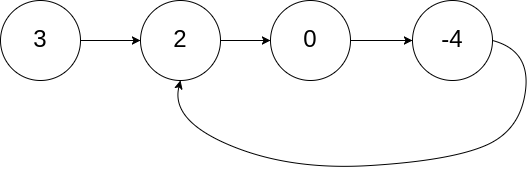
Given
head, the head of a linked list, determine if the linked list has a cycle in it.
Example 1:
Input: head = [3,2,0,-4], pos = 1
Output: true
Example 2:
Input: head = [1], pos = -1
Output: false
class Solution {
    public boolean hasCycle(ListNode head) {
        if(head==null){
            return false;
        }
        ListNode slow=head;
        ListNode fast=head;
        while(fast!=null && fast.next!=null){
            slow=slow.next;
            fast=fast.next.next;
            if(slow==fast){
                return true;
            }
        }
        return false;
    }
}
class Solution:
def hasCycle(self, head):
if not head:
return False
slow = fast = head
while fast and fast.next:
slow = slow.next
fast = fast.next.next
if slow == fast:
return True
return False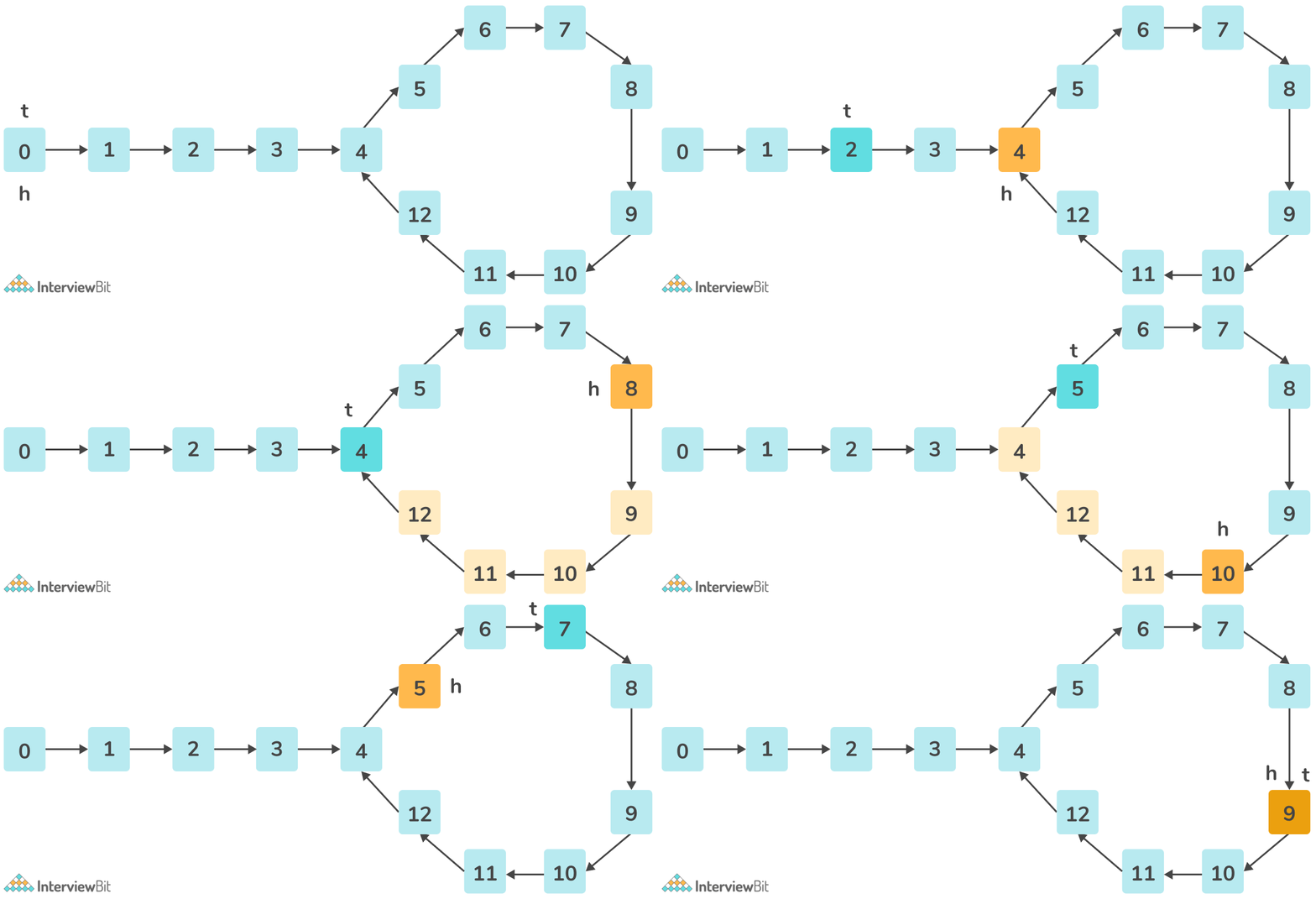
| Type | Value |
|---|---|
| Time | O(n) |
| Space | O(1) |
- Approach: Use Floyd's Tortoise and Hare algorithm. Move slow pointer
by 1 and fast by 2. If they meet, there's a cycle. - Dry run (head=[3,2,0,-4], tail connects to index 1):
- slow=3, fast=3
- slow=2, fast=0
- slow=0, fast=2
- slow=-4, fast=-4 → cycle detected → true
Middle of linked list (leetcode 876)
876. Middle of the Linked List
Given the
headof a singly linked list, return the middle node of the linked list. If there are two middle nodes, return the second middle node.
Input:head = [1,2,3,4,5]
Output:[3,4,5]
Example 2:
Input: head = [1,2,3,4,5,6]
Output: [4,5,6]
class Solution {
    public ListNode middleNode(ListNode head) {
        if(head==null){
            return null;
        }
        ListNode slow=head;
        ListNode fast=head;
        while(fast!=null && fast.next!=null){
            slow=slow.next;
            fast=fast.next.next;
        }
        return slow;
    }
}
class Solution:
def middleNode(self, head):
if not head:
return None
slow = fast = head
while fast and fast.next:
slow = slow.next
fast = fast.next.next
return slow| Type | Value |
|---|---|
| Time | O(n) |
| Space | O(1) |
- Approach: Use two pointers. Move slow by 1 and fast by 2. When fast
reaches the end, slow will be at the middle. - Dry run (head=[1,2,3,4,5]):
- slow=1, fast=1
- slow=2, fast=3
- slow=3, fast=5
- fast.next=null → stop → middle = 3
Remove nth node from end of linked list (leetcode 19)
19. Remove Nth Node From End of List
Given the
headof a linked list, remove thenthnode from the end of the list and return its head.
Example 1:
Input: head = [1,2,3,4,5], n = 2
Output: [1,2,3,5]
Example 2:
Input: head = [1], n = 1
class Solution {
    public ListNode removeNthFromEnd(ListNode head, int n) {
        ListNode slow = head;
        ListNode fast = head;
        for (int i = 0; i <= n; i++) {
            if (fast == null) return head.next;
            fast = fast.next;
        }
        if (fast == null) return head.next;
        while (fast != null) {
            slow = slow.next;
            fast = fast.next;
        }
        slow.next = slow.next.next;
        return head;
    }
}
class Solution:
def removeNthFromEnd(self, head, n: int):
dummy = ListNode(0, head)
slow = fast = dummy
for _ in range(n + 1):
if not fast:
return dummy.next
fast = fast.next
while fast:
slow = slow.next
fast = fast.next
slow.next = slow.next.next
return dummy.next| Type | Value |
|---|---|
| Time | O(n) |
| Space | O(1) |
- Approach: Maintain a gap of n between fast and slow pointers. When
fast reaches end, slow will be just before the node to remove. - Dry run (head=[1,2,3,4,5], n=2):
- initial: dummy→1→2→3→4→5
- move fast 3 steps → fast at 3
- move both:
- fast=4 slow=1
- fast=5 slow=2
- fast=null slow=3
- delete slow.next (4)
- result: 1→2→3→5
Find Start of Cycle (LeetCode 142)
Given the
headof a linked list, return the node where the cycle begins. If there is no cycle, returnnull.
Example 1:
Input: head = [3,2,0,-4], pos = 1
Output: tail connects to node index 1
Example 2:
Input: head = [1,2], pos = 0
Output: tail connects to node index 0
class Solution {
    public ListNode detectCycle(ListNode head) {
        ListNode slow=head;
        ListNode fast=head;
        while(fast!=null && fast.next!=null){
            slow=slow.next;
            fast=fast.next.next;
            if(slow==fast){
                slow=head;
                while(slow!=fast){
                    slow=slow.next;
                    fast=fast.next;
                }
                return slow;
            }
        }
        return null;
    }
}
class Solution:
def detectCycle(self, head):
slow = fast = head
while fast and fast.next:
slow = slow.next
fast = fast.next.next
if slow == fast:
slow = head
while slow != fast:
slow = slow.next
fast = fast.next
return slow
return None| Type | Value |
|---|---|
| Time | O(n) |
| Space | O(1) |
- Approach: Phase 1: Detect cycle with Floyd's algorithm. Phase 2: Reset slow to head, move both one step at a time until they meet at cycle start.
- Dry run (head=[3,2,0,-4], tail→node 1):
- Phase 1: slow=3,fast=3 → slow=2,fast=0 → slow=0,fast=2 → slow=-4,fast=-4 → meet!
- Phase 2: slow=head=3, fast=-4. Move both by 1: slow=2, fast=0 → slow=0, fast=2 → slow=2, fast=-4... eventually both meet at node 2 (cycle start).
Remove cycle from linked list (GeeksforGeeks)
Given the
headof a linked list that may contain a cycle, remove the cycle if it exists by setting thenextpointer of the last node in the cycle tonull.
Example 1:
Input: head = [1,2,3,4,5], pos=2 (cycle on 3)
Output: [1,2,3,4,5]
class Solution {
    public void removeCycle(ListNode head) {
        if(head==null || head.next==null){
            return;
        }
        ListNode slow=head;
        ListNode fast=head;
        boolean hasCycle=false;
        while(fast!=null && fast.next!=null){
            slow=slow.next;
            fast=fast.next.next;
            if(slow==fast){
                hasCycle=true;
                break;
            }
        }
        if(!hasCycle){
            return;
        }
        slow=head;
        ListNode prev=null;
        while(slow!=fast){
            prev=fast;
            slow=slow.next;
            fast=fast.next;
        }
        prev.next=null;
}
}
class Solution:
def removeCycle(self, head):
if not head or not head.next:
return
slow = fast = head
has_cycle = False
while fast and fast.next:
slow = slow.next
fast = fast.next.next
if slow == fast:
has_cycle = True
break
if not has_cycle:
return
slow = head
prev = None
while slow != fast:
prev = fast
slow = slow.next
fast = fast.next
prev.next = None| Type | Value |
|---|---|
| Time | O(n) |
| Space | O(1) |
- Approach: Detect cycle with Floyd's algorithm. Once cycle start is found, track the previous node. When slow and fast meet at cycle start, set prev.next = null to break the cycle.
- Dry run (head = [1,2,3,4,5], 5 → node 3):
- Phase 1: Detect meeting point at node 4
- Phase 2: Move slow to head, fast stays at meeting
- slow=1 fast=4 → slow=2 fast=5 → slow=3 fast=3 → cycle start found
- prev=5 (tracked during Phase 2) → prev.next = null
- Result: 1 → 2 → 3 → 4 → 5 → null
Merge Two Sorted Lists (leetcode 21)
You are given the heads of two sorted linked lists
list1andlist2.
Merge the two lists into one sorted list. The list should be made by splicing together the nodes of the first two lists.
Return the head of the merged linked list.
Example 1:
Input: list1 = [1,2,4], list2 = [1,3,4]
Output: [1,1,2,3,4,4]
Example 2:
Input: list1 = [], list2 = []
Output: []
Example 3:
Input: list1 = [], list2 = [0]
Output: [0]
class Solution {
    public ListNode mergeTwoLists(ListNode list1, ListNode list2) {
        ListNode dummy = new ListNode(-1);
        ListNode current = dummy;

        while (list1 != null && list2 != null) {
            if (list1.val <= list2.val) {
                current.next = list1;
                list1 = list1.next;
            } else {
                current.next = list2;
                list2 = list2.next;
            }
            current = current.next;
        }
        if (list1 != null) {
            current.next = list1;
        } else {
            current.next = list2;
        }
        return dummy.next;
    }
}
class Solution:
def mergeTwoLists(self, list1, list2):
dummy = ListNode(-1)
current = dummy
while list1 and list2:
if list1.val <= list2.val:
current.next = list1
list1 = list1.next
else:
current.next = list2
list2 = list2.next
current = current.next
current.next = list1 if list1 else list2
return dummy.next| Type | Value |
|---|---|
| Time Complexity | O(n + m) |
| Space Complexity | O(1) (in-place) |
- Dry run (list1=[1,2,4], list2=[1,3,4]):
- Compare 1<=1 → pick list1(1), list1→2
- Compare 2>1 → pick list2(1), list2→3
- Compare 2<=3 → pick list1(2), list1→4
- Compare 4>3 → pick list2(3), list2→4
- Compare 4<=4 → pick list1(4), list1→null
- list1 null → attach list2(4)
- Result: [1,1,2,3,4,4]
Remove Linked List Elements (LeetCode 203)
203. Remove Linked List Elements
Given the
headof a linked list and an integerval, remove all the nodes of the linked list that hasNode.val == val, and return the new head.
Example 1:
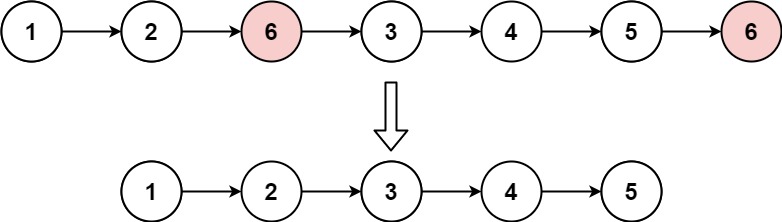
Input: head = [1,2,6,3,4,5,6], val = 6
Output: [1,2,3,4,5]
Example 2:
Input: head = [], val = 1
Output: []
Example 3:
Input: head = [7,7,7,7], val = 7
Output: []
class Solution {

    public ListNode removeElements(ListNode head, int val) {
        ListNode dummy = new ListNode(-1);
        dummy.next = head;
        ListNode curr = dummy;
        while (curr.next != null) {
            if (curr.next.val == val) {
                curr.next = curr.next.next;
            } else {
                curr = curr.next;
            }
        }
        return dummy.next;
    }
}
class Solution:
def removeElements(self, head, val: int):
dummy = ListNode(-1)
dummy.next = head
curr = dummy
while curr.next:
if curr.next.val == val:
curr.next = curr.next.next
else:
curr = curr.next
return dummy.next| Type | Value |
|---|---|
| Time | O(n) |
| Space | O(1) |
- Approach: Use a dummy node to easily handle cases where the head itself needs to be removed. Iterate through the list using a
currpointer and skip over nodes that matchval. - Dry run (head=[1,2,6,3,4,5,6], val=6):
- dummy=[-1], curr=dummy, curr.next=[1]
- Iterates past 1, 2. curr at 2. curr.next is 6.
- curr.next.val == 6. Skip 6 -> curr.next = [3].
- Iterates past 3, 4, 5. curr at 5. curr.next is 6.
- curr.next.val == 6. Skip 6 -> curr.next = null.
- Returns dummy.next -> [1,2,3,4,5].
Remove Duplicates from Sorted List (LeetCode 83)
83. Remove Duplicates from Sorted List
Given the
headof a sorted linked list, delete all duplicates such that each element appears only once. Return the linked list sorted as well.
Example 1:
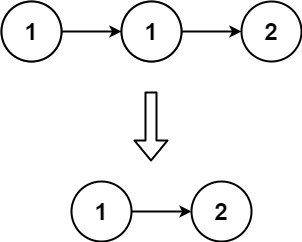
Input: head = [1,1,2]
Output: [1,2]
Example 2:
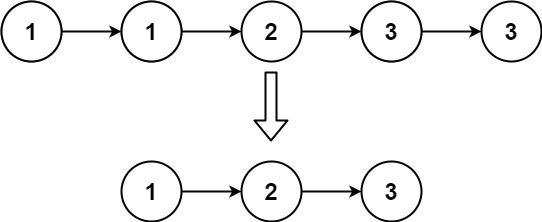
Input: head = [1,1,2,3,3]
Output: [1,2,3]
class Solution {

    public ListNode deleteDuplicates(ListNode head) {
        ListNode curr = head;
        while (curr != null && curr.next != null) {
            if (curr.val == curr.next.val) {
                curr.next = curr.next.next;
            } else {
                curr = curr.next;
            }
        }
        return head;
    }
}
class Solution:
def deleteDuplicates(self, head):
curr = head
while curr and curr.next:
if curr.val == curr.next.val:
curr.next = curr.next.next
else:
curr = curr.next
return head| Type | Value |
|---|---|
| Time | O(n) |
| Space | O(1) |
- Approach: Since the linked list is sorted, duplicates are grouped together. Iterate with a
currpointer and if it's identical to the next node's value, skip the next node. - Dry run (head=[1,1,2,3,3]):
- curr=1. curr.next is 1. Match -> skip the next 1 -> curr.next=[2...].
- curr=1. curr.next is 2. No match -> curr=2.
- curr=2. curr.next is 3. No match -> curr=3.
- curr=3. curr.next is 3. Match -> skip the next 3 -> curr.next=null.
- curr=3. curr.next is null -> loop ends.
- Returns [1,2,3].
Reorder List (LeetCode 143)
You are given the head of a singly linked-list. The list can be represented as:
L0 → L1 → … → Ln - 1 → Ln
Reorder the list to be on the following form:
L0 → Ln → L1 → Ln - 1 → L2 → Ln - 2 → …
You may not modify the values in the list's nodes. Only nodes themselves may be changed.
Example 1:

Input: head = [1,2,3,4]
Output: [1,4,2,3]
Example 2:

Input: head = [1,2,3,4,5]
Output: [1,5,2,4,3]
class Solution {
    public void reorderList(ListNode head) {
        if (head == null || head.next == null)
            return;

        ListNode slow = head, fast = head;
        while (fast.next != null && fast.next.next != null) {
            slow = slow.next;
            fast = fast.next.next;
        }

        ListNode second = slow.next;
        slow.next = null;
        ListNode prev = null;

        while (second != null) {
            ListNode next = second.next;
            second.next = prev;
            prev = second;
            second = next;
        }
        second = prev;
        ListNode first = head;
        while (second != null) {
            ListNode fNext = first.next;
            ListNode sNext = second.next;

            first.next = second;
            second.next = fNext;

            first = fNext;
            second = sNext;
        }
    }
}
class Solution:
def reorderList(self, head):
if not head or not head.next:
return
slow = fast = head
while fast.next and fast.next.next:
slow = slow.next
fast = fast.next.next
second = slow.next
slow.next = None
prev = None
while second:
next_node = second.next
second.next = prev
prev = second
second = next_node
second = prev
first = head
while second:
f_next = first.next
s_next = second.next
first.next = second
second.next = f_next
first = f_next
second = s_next| Type | Value |
|---|---|
| Time | O(n) |
| Space | O(1) |
- Approach: Find the middle node using slow and fast pointers. Reverse the second half of the list. Then, merge the two halves alternately.
- Dry run (head=[1,2,3,4]):
- Middle: slow stops at 2 (so left half is [1,2], right half starts at 3).
- Reverse second half: [3,4] becomes [4,3].
- Merge: 1 -> 4 -> 2 -> 3 -> null. Result: [1,4,2,3].
Convert Sorted List to Binary Search Tree (LeetCode 109)
109. Convert Sorted List to Binary Search Tree
Given the
headof a singly linked list where elements are sorted in ascending order, convert it to a height-balanced binary search tree.
Example 1:
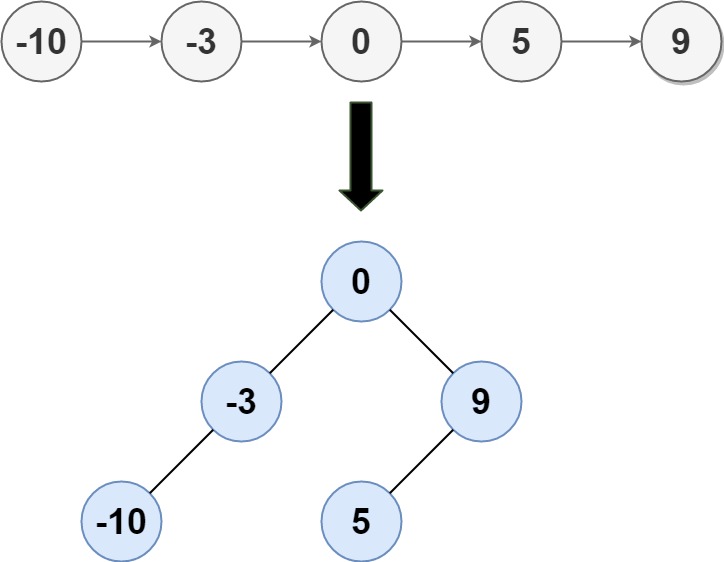
Input: head = [-10,-3,0,5,9]
Output: [0,-3,9,-10,null,5]
Explanation: One possible answer is [0,-3,9,-10,null,5], which represents the shown height balanced BST.
Example 2:
Input: head = []
Output: []
class Solution {
    public TreeNode sortedListToBST(ListNode head) {
        if (head == null)
            return null;
        if (head.next == null)
            return new TreeNode(head.val);
        ListNode slow = head, fast = head, prev = null;
        while (fast != null && fast.next != null) {
            prev = slow;
            slow = slow.next;
            fast = fast.next.next;
        }
        if (prev != null)
            prev.next = null;
        TreeNode root = new TreeNode(slow.val);
        root.left = sortedListToBST(head == slow ? null : head);
        root.right = sortedListToBST(slow.next);
        return root;
    }
}
class Solution:
def sortedListToBST(self, head):
if not head:
return None
if not head.next:
return TreeNode(head.val)
slow = fast = head
prev = None
while fast and fast.next:
prev = slow
slow = slow.next
fast = fast.next.next
if prev:
prev.next = None
root = TreeNode(slow.val)
root.left = self.sortedListToBST(head if head != slow else None)
root.right = self.sortedListToBST(slow.next)
return root| Type | Value |
|---|---|
| Time | O(n log n) |
| Space | O(log n) |
- Approach: Find the middle element to be the root. Set previous node's next to null to sever the list. Then recursively build the left and right subtrees.
- Dry run (head=[-10,-3,0,5,9]):
- Middle is 0. Root = 0.
- Left list turns into [-10,-3], mid is -3 -> root.left=-3.
- Right list turns into [5,9], mid is 9 -> root.right=9.
- End result: [0,-3,9,-10,null,5].
You are given two non-empty linked lists representing two non-negative integers. The most significant digit comes first and each of their nodes contains a single digit. Add the two numbers and return the sum as a linked list.
You may assume the two numbers do not contain any leading zero, except the number 0 itself.
Example 1:
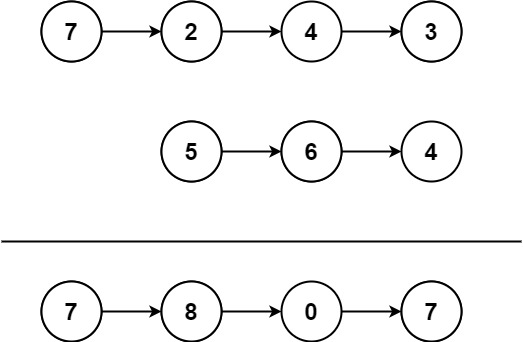
Input: l1 = [7,2,4,3], l2 = [5,6,4]
Output: [7,8,0,7]
Example 2:
Input: l1 = [2,4,3], l2 = [5,6,4]
Output: [8,0,7]
Example 3:
Input: l1 = [0], l2 = [0]
Output: [0]
import java.util.*;
class Solution {
    public ListNode addTwoNumbers(ListNode l1, ListNode l2) {
        Stack<Integer> s1 = new Stack<>();
        Stack<Integer> s2 = new Stack<>();
        while (l1 != null) {
            s1.push(l1.val);
            l1 = l1.next;
        }
        while (l2 != null) {
            s2.push(l2.val);
            l2 = l2.next;
        }
        int carry = 0;
        ListNode head = null;
        while (!s1.isEmpty() || !s2.isEmpty() || carry != 0) {
            int x = s1.isEmpty() ? 0 : s1.pop();
            int y = s2.isEmpty() ? 0 : s2.pop();
            int sum = x + y + carry;
            carry = sum / 10;
            ListNode node = new ListNode(sum % 10);
            node.next = head;
            head = node;
        }
        return head;
    }
}
class Solution:
def addTwoNumbers(self, l1: Optional[ListNode], l2: Optional[ListNode]) -> Optional[ListNode]:
s1, s2 = [], []
while l1:
s1.append(l1.val)
l1 = l1.next
while l2:
s2.append(l2.val)
l2 = l2.next
carry, head = 0, None
while s1 or s2 or carry:
total = (s1.pop() if s1 else 0) + (s2.pop() if s2 else 0) + carry
carry = total // 10
node = ListNode(total % 10)
node.next = head
head = node
return head| Type | Value |
|---|---|
| Time | O(m+n) |
| Space | O(m+n) |
- Approach: Use two stacks to process the numbers starting from the least significant digit, appending digits as nodes to the head.
- Dry run (l1=[7,2,4,3], l2=[5,6,4]):
- push to s1=[7,2,4,3], s2=[5,6,4]
- pop 3, 4 -> sum=7. head=[7]
- pop 4, 6 -> sum=10. carry=1. node=[0], head=[0,7]
- pop 2, 5 -> sum=8. head=[8,0,7]
- pop 7, 0 -> sum=7. head=[7,8,0,7]
- Result: [7,8,0,7]